
A collaborative project between the Klassik Stiftung Weimar (Museum Directorate / Cross-departmental Directorate for Digital Transformation) and the Faculty Design+Bauen at Coburg University of Applied Sciences and Arts
Young professionals from the Integrated Product Design and Interior Architecture programs at Coburg University will present their innovative ideas and concepts related to the “Goethe-Apparat” of the Klassik Stiftung Weimar on July 16 from 2:00 pm to 5:30 pm and on July 17 from 10:00 am to 3:00 pm During the two-day pop-up presentation »Ctrl+Goethe: Next Level Up« in the lecture hall of the Goethe National Museum, visitors can explore the further-developed interactive and immersive prototypes of a digital version of Goethe’s study in physically experiential exhibition scenarios—with free admission.

Foto: Klassik Stiftung Weimar, Fotothek
Semester: Sommer 26
Lehrformat: Projekt mit seminaristischem Unterricht
Integriertes Produktdesign (B.A.) und Innenarchitektur (B.A.)
Kooperationspartner: Hochschule Coburg, Klassik Stiftung Weimar, Creapolis Coburg

Hochschule Coburg
Prof. Dr. Michael Markert,
Prof.in Katharina Bonhag-De Rosa,
Mario Weise
Laura Kathrin Ankenbauer,
Lilli Blaschke,
Luisa Eichfelder,
Tikva Hahma,
Matthis Kerksiek,
Moritz Kirchner,
Magdalena Lisker,
Paul Maier,
Solvey Roth,
Tim Schumacher,
Victoria Tiefel,
Michael Tribus,
Sahara Wagner,
Susan Marlen Wolfram,
Michaela Zech
sowie Studierende
der Innenarchitektur
Klassik Stiftung Weimar
Dr. Dirk Wintergrün,
Kristina Johannes,
u.a.
Plakat: Magdalena Lisker aufbauend auf einen Entwurf von Matthis Kerksiek
Digital Access to Goethe’s Study
Building on the »Goethe-Apparat« pilot project, aspiring product designers have reimagined Johann Wolfgang von Goethe’s study and workroom. In the museum setting, visitors are permitted only to view Goethe’s original study—not to enter it—but these digital applications now open up new ways to engage with it. The goal of the project is to combine state-of-the-art 3D digitization methods with intuitive, user-friendly controls, making the digital version of Goethe’s workspace accessible and engaging for a broad audience. The students’ innovative interaction concepts address design, technological, and social considerations alike. The new surveying of historic spaces using current technologies was also relevant to the students’ education: To carry out AI-assisted 3D digitization, the students were granted access to selected historic spaces and learned how to address conservation challenges. Added to this is the question of representation: What remains of Goethe when one views a digitized image?


»It certainly makes a difference which medium is used to experience a virtual space: a book, a photo album, a planetarium, a smartphone screen, or VR goggles—perhaps even as a small AR model on my desk or a 1:1 scale model that I can walk around in.«
Prof. Dr. Michael Markert
Prof. Markert, who initiated the collaboration with the Interface Design Lab in 2024, is pleased that Professor Katharina Bonhag-De Rosa is fostering a partnership between interior architecture and product design. Interdisciplinary collaborations are important and necessary in all fields. This partnership has generated significant momentum where topics in interior design intersect with product and interaction design, and where substantive issues—such as historical representation, technical implementation, and fire safety regulations—come together.
Together with Prof. Markert, the Interface Design Lab develops interactive technologies and products and was able to test and implement new methods of spatial digitization again this year. The pop-up exhibitions serve not only to professionalize presentations but also as a living usability lab: During the exhibitions, diverse feedback is collected, users are observed, and design conclusions are drawn from these observations.
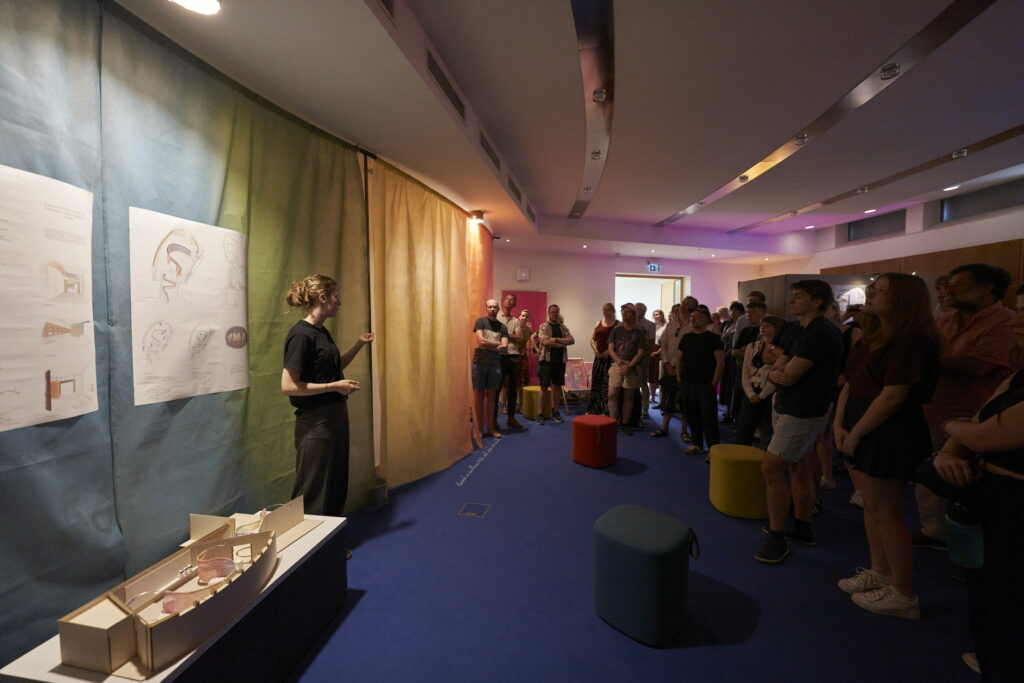
Foto: Klassik Stiftung Weimar, Fotothek, 2026


Foto: Klassik Stiftung Weimar, Fotothek, 2026


Foto: Klassik Stiftung Weimar, Fotothek, 2026
Meanwhile, the future interior designers have drafted various narrative frameworks for the new exhibition design, which are intended to introduce visitors to an additional physical meta-level. Furthermore, the project addresses the needs of different visitor groups, with key considerations including, for example, how visitors manage their own physical presence in the space during VR applications, the guidance of movement through the exhibition, and the regulation of sensory stimuli. The goal of the project is to develop, through a participatory process involving all stakeholders, an exhibition architecture that is tailored to visitors’ needs and stimulating for all age groups.
»To explore Goethe’s study in virtual space, interior design students rely on dialogue with spatially configurable elements that can be physically experienced. These subtly guide visitors to the individual stations and encourage them to take action.«
Prof. Katharina Bonhag-De Rosa
»The highly successful collaboration between Coburg University and the Klassik Stiftung Weimar—represented by the Museums Directorate and the Cross-Functional Directorate for ›Digital Transformation‹ — which has been in place since 2024, has now gained another important partner in the Interior Design program,« said Directors Dr. Annette Ludwig and Dr. Dirk Wintergrün.
Testing the Exhibition at the Long Night of Science in Coburg
In May 2026, the opportunity was given to test the current progress of our work as an open workshop-laboratory in front of an audience. Although the digitization process was not yet complete, the group was able to gain insights into how the interactive exhibits were perceived and used. The event also revealed a keen interest in digital outreach and Goethe in this Upper Franconian city. The »City of the Classics« is actually closer than one thinks with just a little over one driving hour and a bullet train connection.


Offenes Labor des Interface Design Lab zur Langen Nacht der Wissenschaften 2026 in Coburg. Foto: Markert
Pop-Up Presentation of Interactive Prototypes at the Goethe National Museum in Weimar
The two-day pop-up exhibition “Ctrl+Goethe: Next Level” will be on view on July 16 and 17, 2026, in the Blue Salon of the Goethe National Museum in Weimar. Admission is free. The exhibits and concepts are part of the ongoing development of an exhibition that will be on view starting in 2026/27 during the renovation-related closure of Johann Wolfgang von Goethe’s residence.
With 31 museums and places of experience as well as 12 UNESCO World Heritage Sites, the Klassik Stiftung Weimar is one of the largest and most important cultural institutions in Germany. The cities of Weimar and Coburg were dynastically linked from the 15th to the 19th century, shaping the connection between these two institutions.
The Interior Design program at Coburg University is not only known for its specializations in Health Architecture, Human-Centered Psychological Aesthetics, and New Work Spaces, but also offers a comprehensive eight-semester curriculum that leads to professional association membership.
The Integrated Product Design program at Coburg University is characterized by a close integration of design, technology, and social relevance, which it demonstrates through practical collaborations such as this one. As early as the summer of 2024, Coburg University’s Interface Design Lab and students presented the first interactive concepts for the »Goethe-Apparat« media station under the title »Ctrl+Goethe«. Project work results in complex, interconnected, and application-oriented products, projects, and discourses.
All seminars focus on practical engagement with the topic, which also extends to the negotiation of design within discourses. An exhibition in the context of a UNESCO World Heritage Site is a socially and scientifically complex undertaking that requires communication with all stakeholders and must be accompanied by design consultation—yet, from the designers’ perspective, with equal curiosity and openness.
Die Arbeiten im Fokus
The works created as part of the project offer a first glimpse of the future »Goethe digital« offerings, through which the Klassik Stiftung Weimar will creatively and inclusively showcase the poet’s historic home and its unique collections during its closure, while adding new perspectives.
»Interaktiver Rahmen«
Michael Markert, Moritz Kirchner, Michael Tribus, Matthis Kerksiek, Susan Wolfram, Magdalena Lisker, Viktoria Tiefel, et al
Matthis Kerksiek’s poetic work »Fenster« gave rise to an interactive picture frame that changes the perspective based on the viewer’s line of sight. The image offers an artificial glimpse into a digital world, thereby retaining its character as a representation of reality with a distinct visual identity.


»Zimmermodell«
Paul Maier & Tim Schumacher
In this model, physical controllers and a virtual environment are intertwined: navigation through the digital space takes place via a physical model of Goethe’s study. A figure is moved directly through the model — and that figure’s perspective determines the view of the digital space. Through various stages of iteration, the installation has been improved both technically and conceptually, offering an accessible and truly intuitive way to navigate and orient oneself within a virtual space.


»AR-beitszimmer«
Tikva Hahma, Solvey Roth, Michaela Zech
The 3D project »AR-beitszimmer« assumes that most visitors have access to mobile devices. Visitors can thus use their own smartphones to access a model of the room, which can even be viewed and explored on a 1:1 scale right in front of the Goethe House. The phone thus becomes a miniature window into a digital environment that overlays the physical space.
In addition, individual, digitally reconstructed, high-resolution models—such as Goethe’s drawing table—can be projected into the room and viewed from all sides, sometimes even from the inside, and can even be used as backdrops for photos and memories.


»Interaktive Color Wheel«
Lilli Blaschke & Luisa Eichfelder, Sahara Wagner & Laura Ankenbauer
What if our own bodies could become controllers? »Interactive Color Wheel« is an installation that allows visitors to explore Goethe’s color wheel using simple hand gestures and thereby, quite literally, gain a better grip on it. Colors can even be mixed using grasping gestures. The installation playfully revisits the relevance of Goethe’s color wheel today, since — unlike Newton — Goethe was convinced that colors evoke specific sensory perceptions through their emotional and sensory effects, and he sought to scientifically investigate this nature of colors.


Siehe auch CTRL+Goethe: Next Level – Projekt Winter 2025/26

Links
- CTRL+Goethe: Next Level Up – Projekt Sommer 2026
- CTRL+Goethe: Next Level – Projekt Winter 2025/26
- CTRL+Goethe – Projekt Sommer 2024
- KSW Interaktiv – Projekt Sommer 2023
- Goethe-Apparat, Klassik Stiftung Weimar
- Das Arbeitszimmer des Dichters in Pixel übersetzt, Pressemitteilung Klassik Stiftung Weimar
Sources
- Sonntag, D. (2026) ‚Weimar: Goethe außer Haus‘ in: ZDF heute journal vom 1. November 2026 (2026) ZDF heute journal. ZDF. Verfügbar unter: https://www.zdfheute.de/video/heute-journal/heute-journal-vom-1-november-2026-100.html (Zugegriffen: 2. November 2026).
- Mitteldeutscher Rundfunk (2026) MDR THÜRINGEN JOURNAL vom 16. Juli. Verfügbar unter: https://www.ardmediathek.de/video/mdr-thueringen-journal/mdr-thueringen-journal-vom-16-juli/mdr/Y3JpZDovL21kci5kZS9iZWl0cmFnL2Ntcy83NzIwYTk4Zi1mMzg5LTRmYWYtOTE0OS1mZjhhNWMwY2Y4ZWU (Zugegriffen: 21. Juli 2026).
- Akhmedova, A. (2026) Goethes Wohnhaus in Weimar schließt – doch ein neues Fenster in seine Welt öffnet sich, Thüringische Landeszeitung TLZ. Weimar: FUNKE Mediengruppe. Verfügbar unter: https://www.tlz.de/lokales/weimar-und-weimarer-land/article412626172/goethes-wohnhaus-in-weimar-schliesst-doch-ein-neues-fenster-in-seine-welt-oeffnet-sich.html (Zugegriffen: 21. Juli 2026).
- Schalk, N. (2026b) Goethes Arbeitszimmer digital entdecken: Coburger Studierende arbeiten mit Klassik Stiftung Weimar, Informationsdienst Wissenschaft. Verfügbar unter: https://nachrichten.idw-online.de/2026/10/30/goethes-arbeitszimmer-digital-entdecken-coburger-studierende-arbeiten-mit-klassik-stiftung-weimar (Zugegriffen: 2. November 2026).
- Schalk, N. (2026c) „Goethes Arbeitszimmer neu entdecken: Coburger Studierende im ZDF“, Hochschule Coburg, 30 Oktober. Verfügbar unter: https://www.hs-coburg.de/news/goethes-arbeitszimmer-neu-entdecken-coburger-studierende-im-zdf/ (Zugegriffen: 2. November 2026).
- Klassik Stiftung Weimar (2026) Das Arbeitszimmer des Dichters in Pixel übersetzt – Klassik Stiftung Weimar. Weimar. Verfügbar unter: https://www.klassik-stiftung.de/service/presse/pressemitteilung/das-arbeitszimmer-des-dichters-in-pixel-uebersetzt/ (Zugegriffen: 25. Oktober 2026).
- Klassik Stiftung Weimar (2026) “CTRL+Goethe- Next Level,” Klassik Stiftung Weimar, 12 January. Available at: https://www.klassik-stiftung.de/ihr-besuch/veranstaltung/ctrl-goethe-next-level/ (Accessed: January 12, 2026).


